
More than placing citations
How SciFlow accompanies academic texts from the first citation to the finished submission
Reference managers are central to academic writing. SciFlow continues the workflow beyond citation, taking the manuscript from the reference manager through to submission.
- Researchfind sources
- Reference managementzotero · citavi · mendeley
- Writingstructured, collaborative
- Formatting5,000+ templates
- Submissionpdf · docx · jats
Why now
Libraries amid new guidelines, tighter budgets, and open questions about AI
Institutions are looking more closely at how researchers and students actually work. AI is changing what is possible and what is expected, budgets are tighter, and tools and services are being reviewed.
Guidelines are being rewritten, tools assessed, training rethought. Institutions and researchers are talking again about how the work is really done.
Whatever answers institutions reach, they are easier to put into practice when they rest on open, established structures with interfaces designed to remain usable.
Sustainability through open structures
Zotero stays Zotero. SciFlow builds on it.
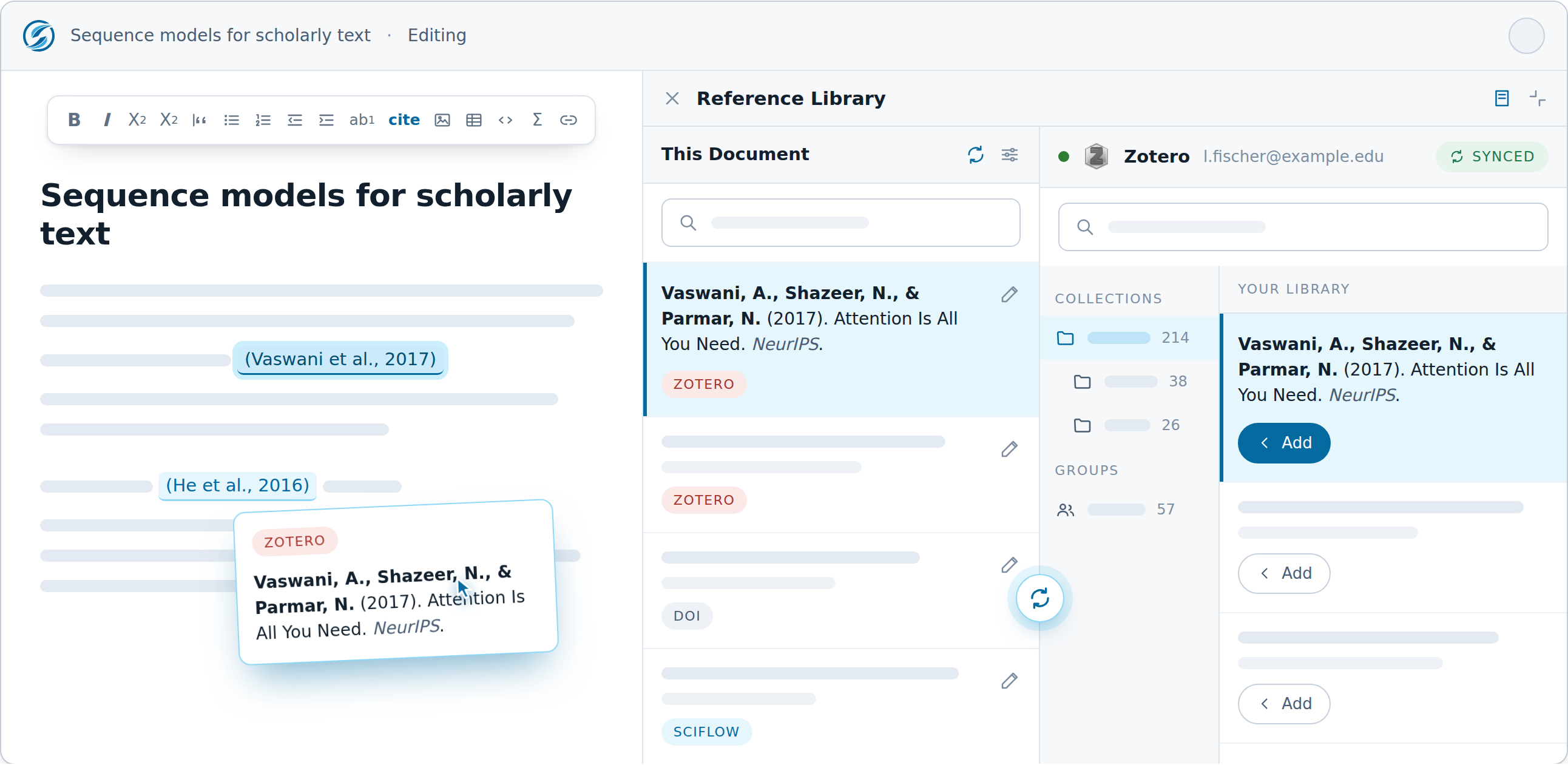
Zotero is open and structured. The library is synchronized with SciFlow rather than handed over once: changes in Zotero are available in the document immediately, and every co-author sees the cited sources without needing an account of their own.
When the literature is available in that form and the writing happens where the citing happens, the workflow does not end at the bibliography. It carries further: structured writing, more than 5,000 journal templates with their citation styles, and export as Word, PDF, HTML, and JATS.
And Citavi?
The Citavi integration existed before and it continues to exist. Anyone moving to Zotero may need to convert individual citation styles from Citavi's proprietary format to open CSL. We help with that.
When choosing tools
A workflow is more than the sum of its tools.
Researchers and students need tools that work well together, not only tools with strong individual features. Structured data exchange connects processes and avoids duplicated work.
A decisive criterion is how readily a tool connects to the systems and processes that follow it.
Until now, support ended here
Reference management stays where it is. What comes after builds on it, without breaks in the chain and without starting over.
Checking references before the manuscript goes out
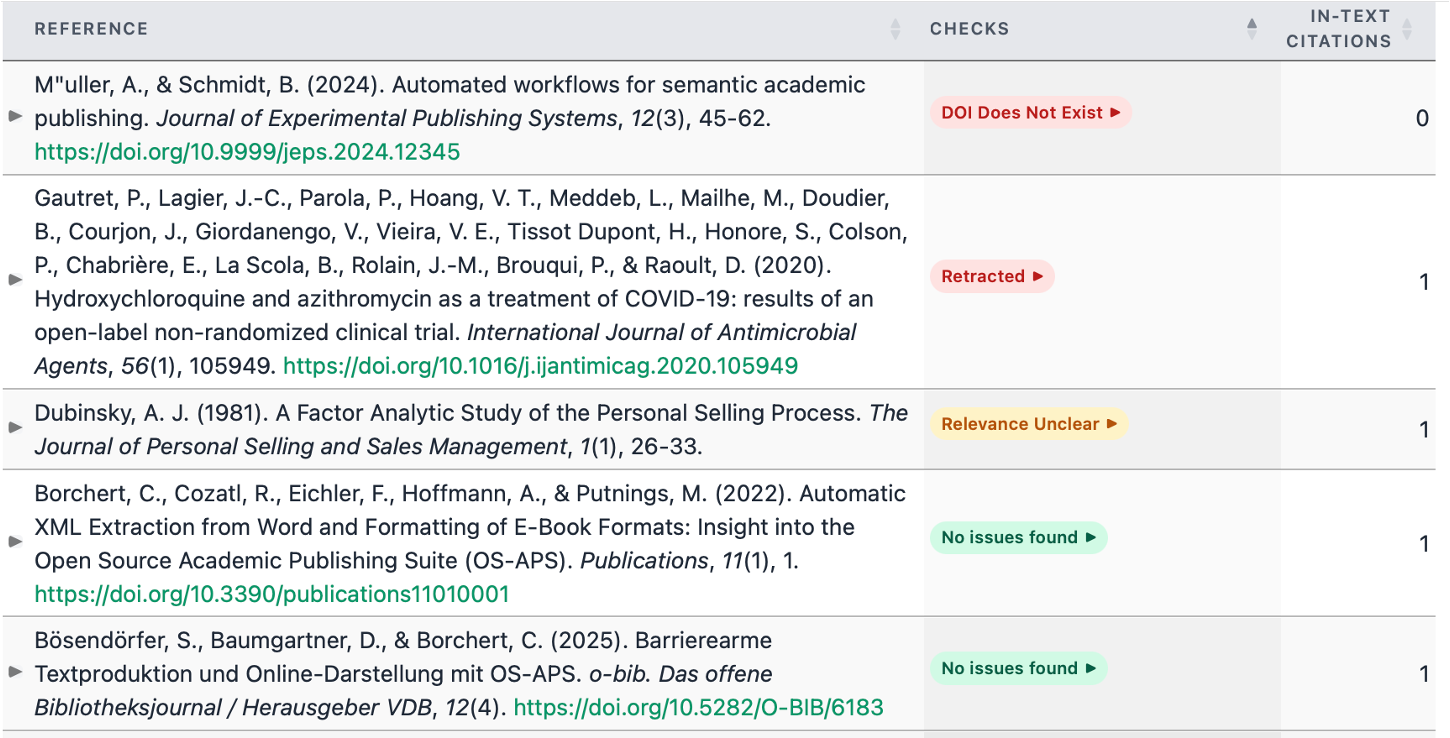
The workflow does not end with writing. When references sit in the text in machine-readable form, they can be checked automatically before submission — for retracted work, faulty sources, or references whose relevance is unclear.
Developed together with Grounded AI. Currently in a pilot.
Already in use at universities
Kassel, Bonn-Rhein-Sieg, and Halle already provide SciFlow centrally

“The most important result is that the formal quality of the work of students who use SciFlow has really improved markedly. Our usage figures have risen continuously, which shows us that it is being taken up very well.”
Neubrandenburg University of Applied Sciences
Through the library since 2023: first for staff, then for students.
University of Kassel
Campus license for all members of the university, since May 2024.
Bonn-Rhein-Sieg University of Applied Sciences
An offer from the library for students and researchers.
University and State Library of Saxony-Anhalt, Halle
Its own training courses for getting started with SciFlow Authoring.


Data storage
German servers only, in ISO-certified data centers in Frankfurt and Karlsruhe.
Sign-in
SSO, OAuth2, and Shibboleth.
Export
Word, PDF, HTML, and JATS — the content stays yours.
Webinar recording for libraries and central services
From the first citation to the finished submission.
In one hour, we traced the workflow from reference management to submission, drawing on what already operates at other institutions, with time for questions.
Recorded on September 17, 2026. The recording is available on Zoom.
Frequently asked questions
FAQ
Does SciFlow replace the reference manager?
No. SciFlow builds on the reference manager and takes over what comes after: structured writing, journal templates, submission.
Do we have to move to Zotero?
No. Interfaces exist for Zotero, Citavi, and Mendeley, along with import from all common programs including EndNote.
What happens to existing Citavi libraries?
The Citavi integration remains. When moving to Zotero it may be necessary to convert individual citation styles from Citavi's proprietary format to open CSL. We help with that.
How is it licensed?
For institutions through the SciFlow Authoring Platform: all students and researchers, unlimited documents and co-authors, your own portal pages, usage reporting, and access to the template database. The offer is based on the number of students and researchers.
How does SciFlow fit into existing library services?
The rollout fits into what a library already offers. SciFlow can be introduced alongside existing reference-management training, for example. Templates and materials come from SciFlow — the library stays the familiar place its researchers turn to.
What exactly do the integrity checks examine?
Five things: whether a cited work has been retracted or carries an editorial notice; whether the source given exists and its metadata is correct; whether a reference fits the context it is cited in; how self-citations and the distribution of authorship compare with what is usual in the field; and whether the list contains entries that are never cited in the text. The result is a report per reference, with a rationale and a recommendation.
What is transmitted during a check?
By default only the bibliography, not the text of the work. Checks that assess context need the full text and have to be enabled explicitly. Processing takes place under a data processing agreement, and the transmitted data is deleted once the report has been produced. The checks currently run as a pilot and are enabled for individual institutions and accounts.
Where is the data held?
On German servers only, in ISO-certified data centers in Frankfurt and Karlsruhe, with encrypted transmission. Documents are not analyzed and not passed on to third parties.
Is sign-in via Shibboleth possible?
Yes. SSO, OAuth2, and Shibboleth are supported.
What do we keep if we stop?
The content can be exported as Word, PDF, HTML, and JATS. Internally, documents are stored in HTML or HTMLBook, and images in their original formats.